




SIP trunking can solve a problem many Filipino businesses do not notice until their phone system starts holding them back. Maybe your team is dealing with missed calls, expensive phone lines, limited extensions, or difficulty connecting employees across different locations.
These issues become more frustrating as a business grows. Adding traditional phone lines can increase costs and make your communication setup harder to manage.
At Prime Tigers Tech Incorporated, we have seen how businesses can simplify their communication systems by moving away from outdated phone infrastructure. Modern business communication should be flexible, reliable, and able to grow with your operations.
This guide explains how the technology works, what SIP does, how it differs from VoIP, and what it may look like in an actual business environment.
1. What Is SIP Trunking?
In simple terms, it is a technology that allows businesses to make and receive calls through an internet connection instead of relying entirely on traditional telephone lines.
SIP stands for Session Initiation Protocol. It is a communication protocol used to start, manage, and end communication sessions over an IP network.
A SIP trunk connects a business phone system, often an IP-PBX, to a telephone service provider through the internet.
Think of it as replacing multiple physical telephone lines with a digital connection.
Instead of installing another physical line every time your company needs more calling capacity, your business can add channels depending on its requirements.
This is particularly useful for growing companies that regularly handle customer calls, sales inquiries, technical support, or communication between branches.
2. What Is the Purpose of a SIP?
Its main purpose is to control communication sessions between devices.
For example, when one employee calls a customer, SIP helps:
- Start the connection between the two parties.
- Identify where the call needs to go.
- Manage the communication session while the call is active.
- End the session once someone hangs up.
SIP can support more than voice calls. Depending on the communication system, it may also be involved in video calls, messaging, conferencing, and other real-time communication services.
For businesses, this creates an opportunity to manage different forms of communication through a more connected digital infrastructure.
Technical configurations can vary depending on the network. For example, businesses researching port forward session initiation protocol (sip) configurations should remember that firewall, router, and security settings need to be handled correctly to avoid connection and call-quality issues.
3. How Does SIP Trunking Work?

Your company’s phone system connects to a SIP service provider through your internet connection. When an employee makes a call, the phone system sends the request through the network instead of using a traditional analog telephone line.
The process may sound technical, but the basic setup is straightforward.
A typical setup includes:
- Business internet connection
- IP-enabled PBX or compatible phone system
- SIP service provider
- IP phones or compatible devices
- Router and network security equipment
Businesses that need a more complete communication setup can also explore our VoIP and SIP solutions for scalable business calling and customer support operations.
Once these components are properly configured, calls can travel digitally from your business phone system to external telephone networks.
Businesses looking for session initiation protocol (sip) in BGC may particularly benefit from evaluating their internet reliability, expected call volume, number of employees, and existing telephone equipment before changing systems.
4. What Is the Difference Between VoIP and SIP Trunking?
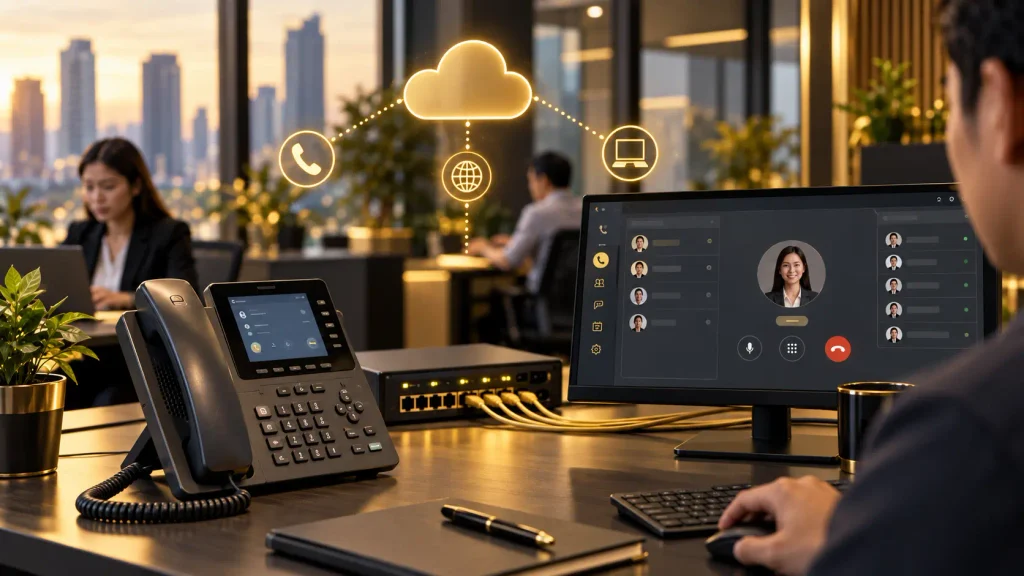
The two terms are connected, but they are not exactly the same.
VoIP, or Voice over Internet Protocol, is the broad technology that allows voice communications to travel through an internet connection.
SIP, on the other hand, is one of the protocols that can be used to manage those communications.
An easy way to understand the difference is this:
- VoIP describes internet-based voice communication.
- SIP helps establish and control communication sessions.
- SIP trunks connect a compatible business phone system to a telecommunications provider over an IP network.
Businesses that are still deciding between communication systems can also read our small business VoIP system guide to understand what to consider before choosing a solution.
The right setup depends on your current equipment, business size, communication requirements, and plans for growth.
5. SIP Trunking Example for a Growing Business

Consider a company in Metro Manila with 40 employees.
Its sales, customer service, accounting, and operations teams all need telephone access. The company also expects to hire 20 more people over the next year.
With a traditional setup, expansion may require additional physical telephone lines and equipment.
With a SIP-based system, the company can increase its calling capacity based on its requirements without installing a separate traditional line for every employee.
Employees can continue using their business extensions while the organization manages calls through a centralized communication system.
For companies researching session initiation protocol sip trunking in Makati, this type of setup may be useful for offices that expect to expand, relocate, or handle increasing call volumes.
6. Key Benefits for Filipino Businesses
Companies handling high call volumes may also benefit from properly planned call center setup services in BGC that integrate connectivity, VoIP, routing, equipment, and technical support.
Lower Communication Costs
Reducing dependence on multiple traditional telephone lines may help businesses control communication expenses.
Easier Business Expansion
Companies can increase calling capacity as their teams grow without completely rebuilding their phone infrastructure.
Better Use of Existing Internet Infrastructure
Voice communication can operate through the company’s IP network instead of requiring separate infrastructure for every telephone line.
Flexible Communication
Depending on the system, employees may be able to use desk phones, computers, or compatible mobile devices for business communication.
Centralized Management
A well-designed phone system makes it easier for administrators to manage extensions, call routing, departments, and communication features.
7. Is It Right for Your Business?
The technology offers useful advantages, but it should not be implemented without reviewing your current network.
Before switching, we recommend checking:
- Internet speed and stability
- Number of simultaneous calls
- Existing PBX compatibility
- Network and firewall configuration
- Business continuity requirements
- Expected company growth
- Call routing requirements
- Security requirements
Call quality depends heavily on a properly configured network. Businesses should also consider whether their broader cloud infrastructure solutions can support reliable networking, monitoring, security, backup, and future growth. Simply connecting a new telephone system to an unreliable internet connection may create more problems instead of solving them.
That is why planning, configuration, and ongoing technical support matter.
Build a Better Business Communication System
Your phone system should help your employees communicate with customers, suppliers, and each other without becoming another technology problem your team has to manage.
At Prime Tigers Tech Incorporated, we help businesses evaluate and implement communication solutions based on their actual operational needs. We can assess your existing setup, network environment, business requirements, and future expansion plans before recommending an appropriate solution.
If your current telephone system is becoming expensive, difficult to expand, or challenging to manage, it may be time to consider a more flexible communication setup.
Contact Prime Tigers Tech Incorporated today to discuss a business communication solution designed for the way your company works and grows.