




If you have ever outsourced an IT task, you already know the first price you see is not always the final price you pay. I have been on both sides of this decision.
I have worked with freelancers for quick fixes and I have partnered with agencies for ongoing support. The surprising part is this. The “cheapest” option on paper can become the most expensive option after delays, rework, and downtime.
This guide is a straight, experience-based breakdown of the real cost of IT outsourcing. Not just the hourly rate. I mean the total cost that shows up in your operations, your timelines, and your stress level.
What “Real Cost” Actually Means
When business owners ask me, “Should I hire a freelancer or an agency?” I answer with one question first.
What is the cost of this project going wrong?
Because the real cost is not just the fee you pay. It is the combination of:
1. Direct costs
- Hourly rates, project fees, retainers
- Software subscriptions, hosting, licenses
- Paid tools for monitoring, backups, or security
2. Indirect costs
- Your time explaining, reviewing, chasing updates
- Slow delivery that delays your sales or operations
- Miscommunication that creates rework
3. Risk costs
- Downtime that stops your team from working
- Security gaps that expose your systems
- Loss of data due to weak backup practices
4. Management costs
- Task management, timelines, QA checking
- Coordination between people when scope changes
I have seen companies spend ₱20,000 on a “cheap” website fix, then spend ₱120,000 later to rebuild the entire thing because the original job was rushed, undocumented, and unsecured.
Agency Vs. Freelancer In Plain Terms
Before we talk about money, let us clarify what you are really buying.
Freelancer
A freelancer is typically one person handling the work. You are paying for a specific skill and their time. This can be great when the scope is simple and clearly defined.
Agency
An agency is a structured team. You are paying for systems, accountability, coverage, and multiple skills. It often includes project management, QA, and processes like documentation and reporting.
Here is the key difference I have experienced.
- Freelancers win on flexibility and speed for small tasks.
- Agencies win on reliability and continuity for ongoing needs.
Cost Breakdown: What You Pay For And What You Do Not See?
A lot of outsourcing decisions fail because the scope is priced, but the workflow is not.
Common pricing models you will see
1. Hourly rate
Best for small tasks or ongoing support with unclear workload.
2. Fixed price project
Best when requirements are clear and stable.
3. Monthly retainer
Best for long-term support, maintenance, and continuous improvements.
The hidden line items people forget
1. Onboarding time
Even the best freelancer or agency needs time to understand your systems, access, and goals.
2. Documentation and handover
If it is not documented, you pay again later when someone new needs to take over.
3. QA and testing
A change that is not tested can break something else. That is where downtime costs show up.
4. Tool stack
Ticketing tools, password managers, monitoring, backup tools, and security scanning can be included or missing. If it is missing, you often end up paying for it later.
This is why comparing rates alone is misleading. A ₱1,000 per hour freelancer with no QA and no documentation can cost more than an agency retainer that includes structured delivery.
Hidden Costs With Freelancers That I Have Seen Often
Let me be clear. There are excellent freelancers. I work with them. But the risk profile is different. These are the hidden costs I have personally encountered in real projects.
1. Single point of failure
If your freelancer gets sick, gets overloaded, or disappears, the project pauses. The technical term is “bus factor,” but the business impact is simple.
YOU ARE STUCK.
2. Response time gaps
Many freelancers work across multiple clients. In urgent situations like a server outage, slow replies become expensive quickly.
3. Limited coverage
One person might be great at development but weak at:
- Security hardening
- Server and DevOps
- Testing and QA
- Documentation and deployment workflows
That is not their fault. It is reality. IT work is too wide for one person to cover everything well.
4. Rework becomes the silent budget killer
This one is the most common. The task is delivered, but it is not scalable, not clean, and not aligned with your future needs. Later, your new provider spends extra time fixing it.
REWORK COSTS ARE REAL COSTS.
Hidden Costs With Agencies That You Should Watch Out For
Agencies are not perfect either. I have seen agency setups fail when the client pays for a “team” but experiences slow communication and unclear ownership.
1. Overhead is built into pricing
Agencies have project managers, senior reviewers, and multiple staff. This is valuable, but it also increases cost.
2. Layered communication
Sometimes it feels like you are talking to an account manager who then relays messages to the team. If this process is slow, you lose time.
3. One-size-fits-all packages
Some agencies push packages that include services you do not need. You should always ask what is included and why.
4. Vendor lock-in risk
If you do not own your admin accounts, code repositories, and documentation, it becomes expensive to switch later.
A trustworthy agency will not hide your assets from you. They will build a clean exit plan from day one.
Real Scenarios: When Each Option Actually Wins
Here is the practical part. This is how I choose, based on real projects I have handled.
Scenario A: You need urgent IT support and reliability
Choose an agency if you need:
- Guaranteed response times
- Ticketing and tracking
- Multiple people available
- Structured escalation when issues get serious
This is where downtime is too expensive to gamble.
Scenario B: You need a small one-time fix
A freelancer can be the best choice when:
- Scope is small and clear
- Risk is low
- You can provide clear instructions
- You can review the output quickly
Scenario C: You have ongoing projects and growth plans
Choose an agency when you need:
- Web development plus SEO plus tracking
- Cloud support plus security plus monitoring
- Continuous improvements every month
A team model becomes cost-effective because you are not rebuilding context every time.
Scenario D: You need a niche expert
Choose a specialist freelancer when you need deep skill in one area, such as:
- A specific API integration
- Advanced performance optimization
- A narrow cybersecurity audit
The Cost Triangle: Quality, Speed, Reliability
This is the reality I explain to clients.
You can usually pick 2:
- Fast and Cheap
- High quality and reliable
If you push for fast and cheap, you often pay later with quality issues.
If you invest in quality and reliability, you reduce rework and downtime. That is why many businesses eventually move to a retainer model. It is not because they want to spend more. It is because they want fewer surprises.
Security And Compliance Are Not Optional Costs
The most expensive outsourcing mistakes I have seen were security-related.
Here are the common issues:
- Shared passwords with no access control
- No password manager
- No backup checks
- No monitoring alerts
- Admin access left active after someone leaves
Whether you hire a freelancer or agency, ask these questions:
- How do you manage credentials and access?
- What is your backup plan and how often is it tested?
- What happens if the site goes down at 2 AM?
- Do we have an incident response process?
If the answers are vague, your risk cost is high.
What To Ask Before You Hire Anyone
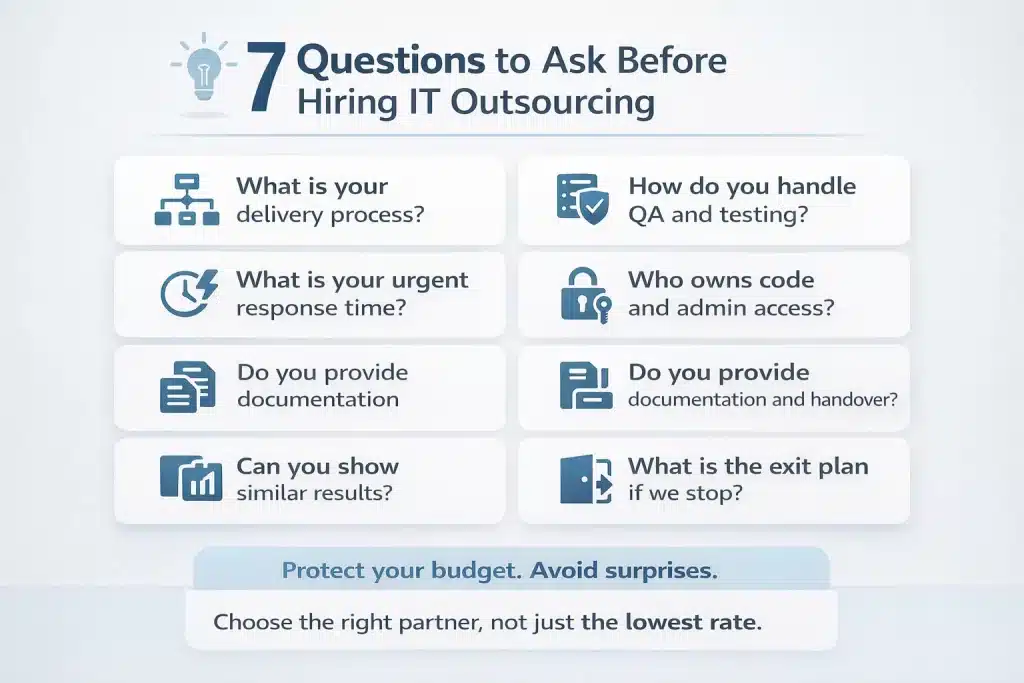
These questions protect your budget. Ask every freelancer or agency:
- What is your delivery process from start to finish?
- How do you handle QA and testing before deployment?
- What is your response time for urgent issues?
- Who owns the code, accounts, and admin access?
- Do you provide documentation and handover?
- Can you share examples of similar work and results?
- What is the exit plan if we stop working together?
A professional will answer clearly and confidently. A risky provider will avoid specifics.
Conclusion: The “Real Cost” Is Outcomes, Not Rates
If you only compare agency vs freelancer by price, you are missing the biggest costs. Rework. Downtime. Lack of documentation. Slow response. Security gaps. These are the costs that quietly drain your business.
Here is the convincing truth from experience.
- If your project is small, clear, and low risk, a freelancer can be a smart move.
- If your project touches operations, security, growth, and ongoing support, an agency is often cheaper in the long run because you buy reliability and coverage.
Work with Prime Tigers Tech Incorporated
If you want IT outsourcing that is reliable, secure, and built for long-term growth, Prime Tigers Tech Incorporated can help you do it the right way. We do not just “fix issues.”
We build stable systems, clear processes, and a support setup you can trust, so your business runs smoothly without surprises.
Here is what we can handle for you:
- Managed IT Support and Helpdesk
- Cloud setup, migration, and server management
- Website and system maintenance with proper documentation
- Security hardening, backups, and monitoring
- Ongoing IT consulting for growing teams
Ready to see the real cost and the best option for your business?
Message Prime Tigers Tech Incorporated today for a quick IT assessment and a clear outsourcing recommendation based on your goals, budget, and risk level.
Let us help you outsource smarter, reduce downtime, and scale with confidence.